Sculpture Park
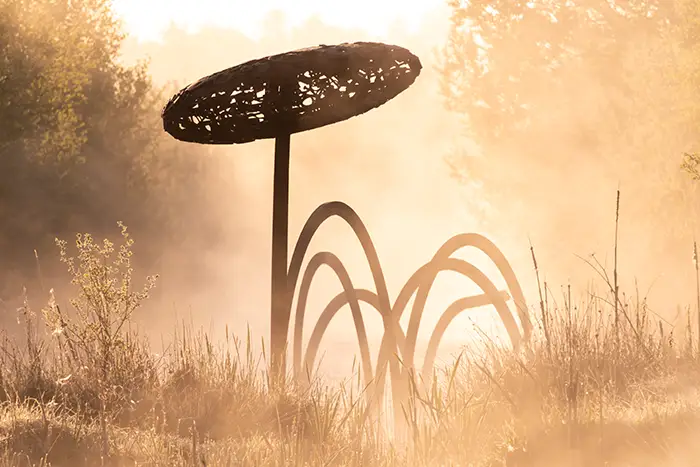
Where art meets nature – Lough Boora is home to some of the most innovative land and environmental sculptures in Ireland. The artists, inspired by the rich natural and industrial legacy of the bog lands, have created a series of large-scale sculptures that are now part of the park’s permanent collection.
As a paradise for outdoor enthusiasts interested in its unique flora and wildlife, the Sculpture Park’s route is enhanced by 24 innovative works of art that dramatically change the landscape with varying contrast depending on the weather, throughout the seasons and over time. Industrial materials of the bog, such as locomotives, rail line, timber and stone have been developed into magnificent sculptures. Over time, the effects of nature have altered the sculptures in colour and developed wonderful colonies of plant growth, enabling them to become part of the landscape once again.
The Sculptures
Paper Boats
Paper Boats
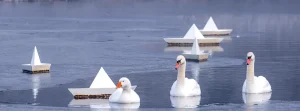
By Amanda Ralph
Concept Description
Amanda Ralph’s ‘Paper Boats’ has been on quite an expedition, as they were commissioned by Offaly County Council in 2000 for the River Brosna in Clara. Two winters later, the river rose considerably after a storm and debris swirled around the chained anchors, dragging some of them under. The OPW were called to dredge the river, and Offaly County Council employee Dominic Fleming spotted the machine hauling the boats onto the riverbank. Rescuing five of the seven, he placed them in storage in Clara, waiting for someone to claim them. Around this time, the Arts Office in Offaly County Council was undergoing a change of personnel and somehow the fate of the rescued boats was overlooked.
Arts Officer, Sinéad O’Reilly says, “When I took up the post in 2005, I found a record of them having being commissioned, but nothing of what had happened to them subsequently. I had heard in conversation that the OPW removed them, but nothing further. In 2014, Amanda contacted us to ask if we knew anything about what had happed to the sculptures. We started to ask questions locally and amazingly we found them, stored in a loft in a depot in Clara. We are very grateful to Dominic Fleming for rescuing the sculptures when he did. He even managed to avoid them being turned into planters over the years! Two of them are still missing, possibly buried into the river bank from when the river was dredged.”
Amanda assessed their condition and brought them to Arklow Marine Services where they had been originally engineered, 14 years earlier. “I was worried that there would be nobody who would remember making them and we’d have difficulty in getting them restored, but Billy Tyrrell, a fifth generation boat builder, recollected them immediately. Arklow Marine are one of the leading boat builders in Ireland, so I imagine a project like this sticks in their minds”.
While being restored, a new home was found for the remaining boats at Lough Boora Discovery Park in the context of its existing Sculpture Park. The boats were placed in Lough an Dochas at the Visitor Centre just before Christmas of 2014. They are the first sculptures visitors encounter at the park from the centre, and their original meaning of a wistful desire for adventure and discovery retains its value here too.
Turf, Wind and Fire
Turf, Wind and Fire
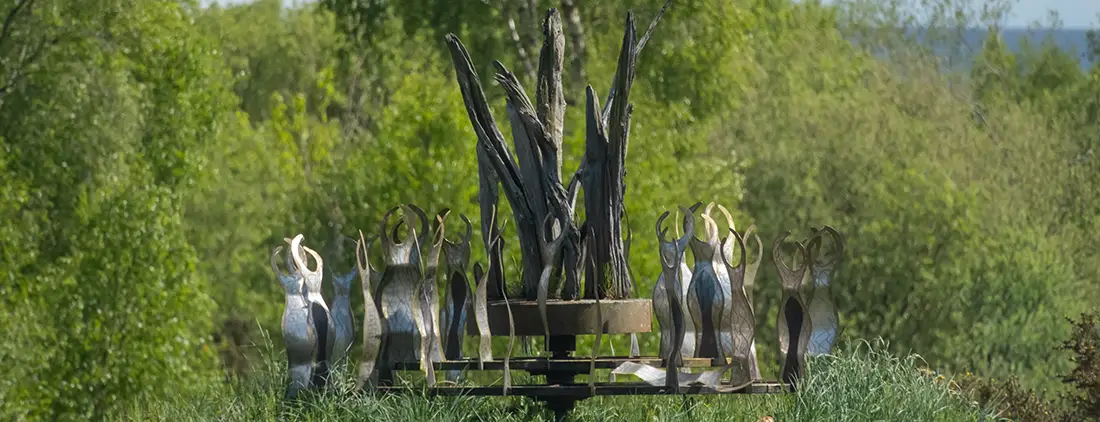
By Ross Hathaway, Paul Coyne and Rosemary Langtry
On a breezy day the “flames” become alive, dancing and reflecting light as they spin.
Concept Description
The concept is centred on creating a dynamic sculpture that breathed life into the soul of static materials. The sculpture aimed to interact with forces of nature while remaining sympathetic to its surroundings. The work paid homage to the heritage of the land.
For all three artists it was important to leave as little environmental impact as possible. Recycled materials were sourced from friends, family and donated by BnM.
Materials Description
The sculpture incorporates industrial and organic materials blending together to create a symbolic beacon. On a breezy day the “flames” become alive, dancing and reflecting light as they spin. Copper has been used with the intention that over time it will produce a green patina symbolic of BnM’s progression into sustainable energy sources.
The materials in the base of the fire are representative of those used throughout the ages in man’s quest for heat sources. Branches, logs, turf and briquettes symbolised by steel pipes and Bog Oak.
The centrepiece is a Bog Oak sculpture that points towards the sky bringing us full cycle – a resource from the past that reaches out into a bright future.
The Gathering of the Stones
The Gathering of the Stones
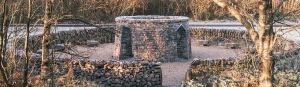
By the Dry Stone Wall Association of Ireland and the Stone Foundation, USA.
Using stones gathered from all around the country, all four provinces of Ireland are represented in the sculpture, using a different stone type and style from each province.
Concept Description
The primary idea was to create a gathering point for people to congregate, and a circle seemed the most appropriate shape to use. The bi-vallate (twin walled) enclosure also reflects Ireland’s built heritage.
The ring fort is the most common archaeological site to be seen in the Irish landscape. The status of a ring fort is not only evident by its diameter but more significantly through the number of rings it contains. Therefore, a bi-vallate enclosure would often be the seat of the local lord or the central focal place for a network of ring forts which formed a community.
The outer wall symbolises the 4 provinces. Thus the Island of Ireland and all its people, with its many varying ways and vernacular styles, forms a comforting embrace around the 5th province. That 5th province once had a physical existence during the Iron Age and was known as Breifne. In addition, in this structure the 5th province also represents the individual, creativity, imagination and the Diaspora.
The structure represents the country of Ireland and a welcome home to the people who left and never returned. The outer walls embrace the creative mind, the millions of souls and talents who left our shores and spread their skills far and wide. It becomes entirely appropriate that the ‘Emigrant Stones’ should be laid in cruciform shape at the centre of the sculpture embracing people from all corners of the world.
Materials Description
All of the stone for this project has been donated by the proud people of Ireland and it is being built entirely by volunteers. There were also a number of stones donated from locations of historical significance to Irish people including Battery Park in New York, Breakwater quarry stone from Holyhead in Wales, stone from The Ffestiniog Railway in Wales as well as stones donated by the Dry Stone Wall Association of the UK.
Sculptor’s Bio
The Dry Stone Wall Association of Ireland and the Stone Foundation, USA came together with the vision to invite the international community ‘home’ for a Gathering of Stones in the geographical centre of Ireland.
System No.30
System No.30
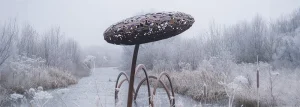
By Julian Wild
A serpentine of metal, inspired by the industrial heritage of the parklands, skimming along the canal’s surface.
Concept Description
The concept is that of a disk that appears to bounce over the surface of the canal, like a skimming stone. This is an imaginative and playful piece which looks like a serpentine form swimming across the surface of the canal.
Materials Description
Over the space of two years Julian Wild has gleaned pieces of metal scrap from the BnM workshops in Lough Boora. He sees the process as a kind of archaeology in which each old cog and piece of metal tells part of the story of the sites’ rich industrial heritage.
Welding these scrap pieces of peat wagons and cutting machinery together, the artist has constructed an 18m long sculpture in a canal at the parklands.
Sculptor’s Bio
This sculpture is part of a series of works by Julian Wild called “Systems”, which are subsequently numbered, this being number 30 in the series. Julian began his “System” series in 2003, which has involved working with self contained sculptures, installations, drawings and public art projects.
Development and installations of this piece of work took place over a three week period from 31 August to 18 September 2009 and involved the collaboration and support of a number of groups: BnM, Sculpture in the Parklands, Offaly County Council, Lough Boora Parklands Group, Coillte and the Arts Council.
Passage
Passage
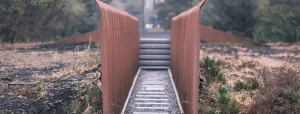
By Alan Counihan
A trench passageway of railway sleepers beneath the turf bank surface.
Concept Description
Alan Counihan’s piece entitled “Passage” involved cutting a trench into a raised bank of turf, creating a passageway lined with railway sleepers, leading to free standing vertical rails and sleepers which reach towards the sky. On working on this piece the artist wished to explore man’s relationship with his landscape, how it is inhabited, remembered and imagined.
Alan expressed a desire to “explore beneath the great flatness of Boora bog so that the experience of engagement with the work might also feel like an engagement with time, the past and the processes of material decay.”
Development and installations of this piece of work took place over a three week period from 31 August to 18 September 2009 and involved the collaboration and support of a number of groups: BnM, Sculpture in the Parklands, Offaly County Council, Lough Boora Parklands Group, Coillte and the Arts Council.
For a more in depth look at the development of this piece check out the videos below.
Sky Train
Sky Train
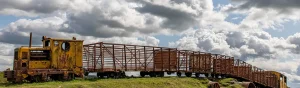
By Michael Bulfin
An old motionless ‘Rustin’ train and open creel type wagons celebrating the machinery and people who once worked on them over the years.
Concept Description
“Having grown up in the area, my abiding memory is of the machines that BnM brought in to work the bogs: the ditchers, ridgers and trains. Looking at a line of peat wagons, flat on the horizon” – Michael Bulfin.
Michael decided to take this image and commemorate it by translating it into a sculptural context – using the BnM trains and wagons in a different plane – hence the introduction of the “rainbow” curve.
To put emphasis on the train going up into the sky, ditcher wheels were introduced to form tunnels in the supporting mound so the light can be seen through it. The engine is a ‘Rustin’, one of the oldest models and the wagons are of the open creel type, reminiscent of the creels used to carry turf on horse or donkey. This piece is a celebration of the BnM machines and the men who operated them.
Sculptor’s Bio
Michael Bulfin was born in Birr, County Offaly, and graduated in Environmental Science from Yale University.
He was a founder of the Projects Arts Centre in Dublin, and was, for seven years, Chairman of the Sculptors Society of Ireland. He has exhibited widely in Ireland, participating in major exhibitions in the 1970s and 1980s, as well as solo exhibitions.
He has also participated in numerous international exhibitions and symposia in the United States, Paris, London, Liverpool and Copenhagen. Recent work includes Echoes of the Past-Traces of the Future, a 100m long drawing in the landscape consisting of three low embankments that winds into a spiral form.
The Boora Pyramid
The Boora Pyramid
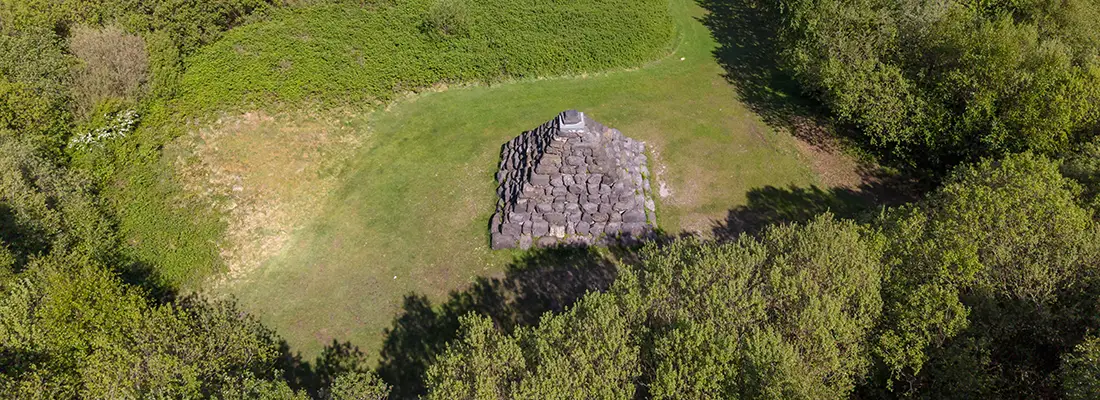
By Eileen MacDonagh (Ireland) assisted by Marc Wouters (Belgium)
A stepped pyramid of unmortared glacial stone which has resonance with previous times and cultures.
Concept Description
Eileen McDonagh always wanted the opportunity to make a large work in the landscape. The idea of a pyramid was one which evolved during visits to the site and discussions with BnM about the materials available in the area. The pyramid is one of the most stable structures and has resonance with previous times and cultures.
Materials Description
The work is a stepped pyramid, 8m wide and nearly 6m high. It is made from unmortared stone which had been enshrouded in the growing bogs until revealed once more during peat harvesting.
Boora Convergence
Boora Convergence
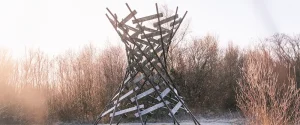
By David Kinane
A tower arrangement of steel and wood symbolising the industrial heritage of the bog.
Concept Description
Like other artists at Lough Boora Parklands, Kinane noticed the industrial bog is criss-crossed by lines of machine cuts, drains and railways. While observing this he was also drawn to the image of the Ferbane cooling towers. The towers ironically, while appearing to be all curves, are in fact made of straight lines arranged in a circle.
From the exterior the sculpture offers an open patterned lattice and the interior provides a view of the sky framed by a swirling upward movement.
The lines of the piece can be imagined to converge at this place from infinity. Organic wood and machine steel combine in it. Skill and creativity connect between art and the artisans at the Boora workshops.
Materials Description
The artist used the steel and wood of the railway to arrange them in a circle and build a stable, skeletal construction. Kinane referenced the industrial heritage of the cutaway bog in the choice of materials and by the form they take.
Burrow Shelter
Burrow Shelter
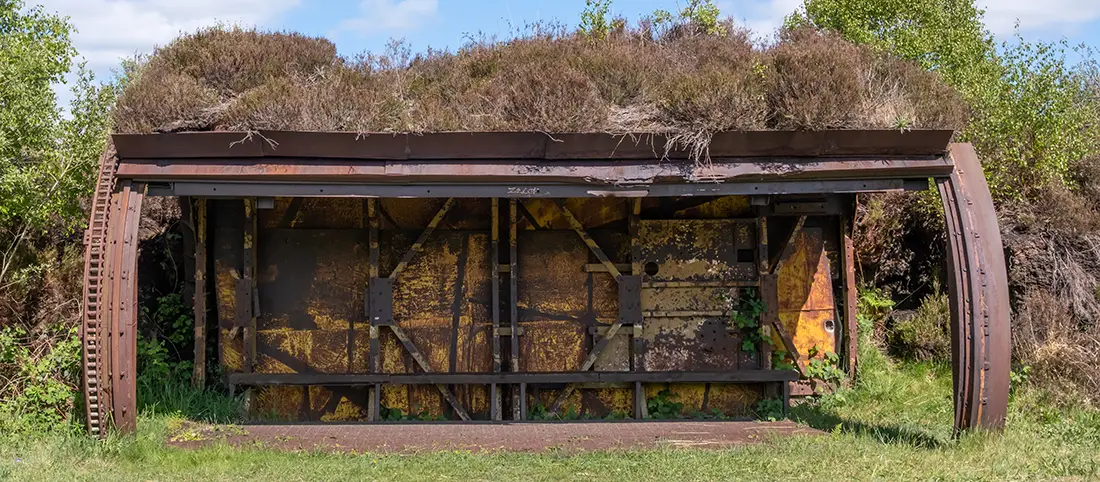
By Caelen Bristow
A shelter embedded in the landscape, made from the old steel tipplers once used in the production process.
Materials Description
This piece was developed from the old tipplers at Ferbane Power Station which was decommissioned in 2000 AD. The tipplers were used to empty the wagons of peat as they came in from the bog by rolling over the wagon of peat and emptying their contents onto the conveyor belt that brought the peat to the power plant at the time.
Cycles
Cycles
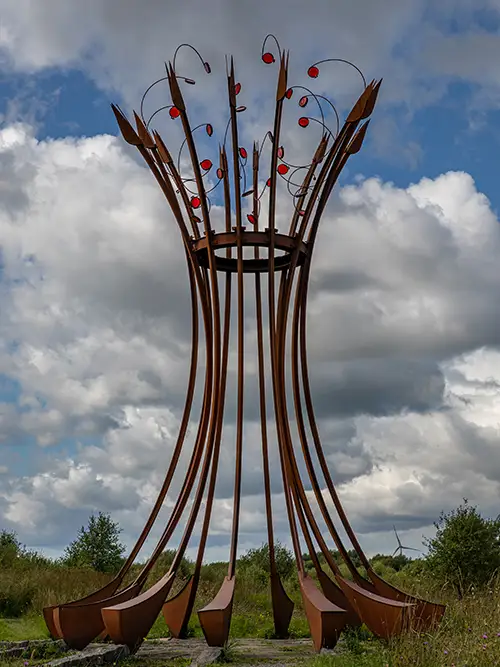 By Caroline Madden
Old train rail steel used to represent the cycles of life.
Concept Description
The work Cycles is a conglomeration of ideas derived of Lough Boora Parklands’ inherently beautiful landscape and wealth of cultural heritage. It focuses on the cyclical nature of land and mankind’s interaction, be it ownership or the purpose for which the land is used.
The overall sculptural form proposes a crown referencing the early Kingship of Ireland. At the base of the sculpture are twelve blade forms, symbolic of blades engaged to cultivate the earth. The raised linear stone wall which emanates from each blade into the landscape stands, as a recorded memory of the scaring required in bringing forth new life.
New life is represented by the red seed forms spiralling out from the top of each arc to start a new cycle. The regal colour red simultaneously symbolizes life and death thus, providing a complete cycle.
Materials Description
An arc fabricated from a recycled BnM train rail that had been originally used for harvesting peat positions the blade form. These arcs reach up into the sky then bend at the top to signify growth bending under the weight of fruit that is new life.
60 Degrees
60 Degrees
By Kevin O’Dwyer
A series of triangles made from disused railway tracks, sleepers and steel which interact with each other by using the movements of the sun throughout the day.
Concept Description
While walking in Lough Boora Parklands on a winter’s afternoon, the artist was fascinated by the strong directional light and the shadows it cast on this unencumbered landscape. He decided to use a series of equilateral triangles of decreasing size that would cast shadows on the landscape and interact with each other as the sun moved during the morning and evening hours.
Materials Description
The sculpture was fabricated from materials long associated with the industrial heritage of the cutaway bog- railway track, railway sleepers and steel plate. Two of the triangular forms were made from oak sleepers bolted to a steel armature; the sleepers were removed from a disused bog train railway line laid in the 1950’s. The wood triangles symbolised the old use of the bog.
The centre triangle was made from stainless steel and symbolises the new use of the parklands. The triangular icons are held in place using railway track, which once facilitated the movement of peat to the Ferbane power station by the bog train.
Sculptor’s Bio
Kevin O’Dwyer’s artwork has explored the subtleties of ritual and imagination. Irish prehistoric art, bronze-age artefacts, early monastic metalwork, 20th century design and architecture are his creative influences. Equipped with this visual vocabulary, Kevin creates artefacts that often combine the textured surfaces and flowing lines of our past with the strong and austere forms of modern architecture. The ultimate goal is to create a work of art that is timeless, thought provoking and responsive to the human spirit.
Earth & Sky
Earth & Sky
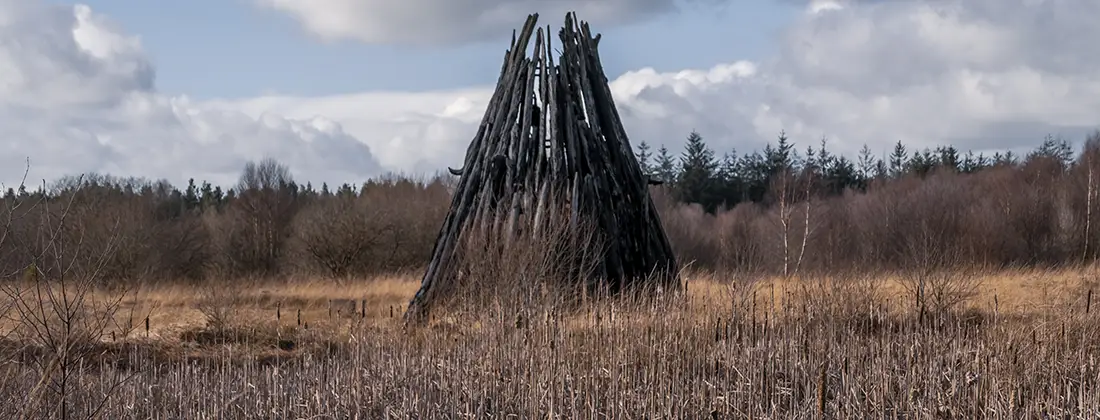
By Alfio Bonanno
A reminder that nature is both a spiritual source and practical provider for humanity’s needs.
Concept Description
His ‘Earth and Sky’ sculpture embraces the concept of maximising the use of nature. The circles of the interior represent the rhythms of the sky and the landscape, rotating and wheeling around each other.
Materials Description
The sculpture is based on five circles rising into the sky, ranging in diameter from 7 metres at the bottom, to two metres at the top. The sculpture is also an impressive 7 metres tall, and its outer structure consists of large pieces of natural wood resting on the round framework.
Sculptor’s Bio
Bonanno has extended the language of outdoor installation through his artistry. His concerns are as much social as environmental. As Bonanno states: “The ‘other landscape’ exists at a closer look—here—where we have always been, where we least expect to find it—there it is. Where earth meets air, and water meets the sun, we see myriads of vital life cycles. And life arises, where it is given a chance to exist: on the cracked boards of a train wagon in movement, in the midst of a concrete footpath, and on roof tops.” (From “A Conversation with Alfio Bonanno” by John Grande)
Lough Boora Triangle
Lough Boora Triangle
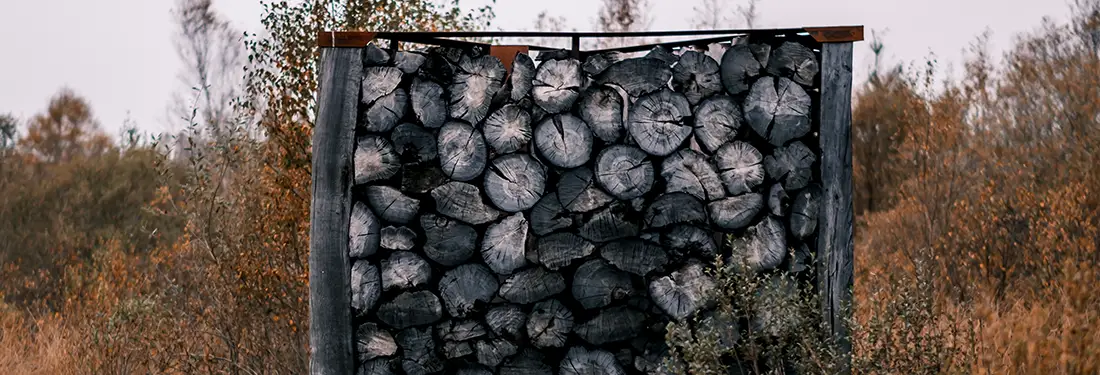
By Jørn Rønna
An outdoor triangular resting area developed using bog oak trunks and varied pieces of bog wood.
Concept Description
A space for meditation. A small triangular room with a very special atmosphere.
Materials Description
Built around an iron frame, three black, bog oak trunks form the corners; shaped irregular pieces of bog wood form the somewhat transparent walls. The narrow entrance is marked by a triangular serpent stepping plate. Inside is a seat where visitors can sit looking out of the narrow entrance toward the horizon.
Tippler Bridge
Tippler Bridge
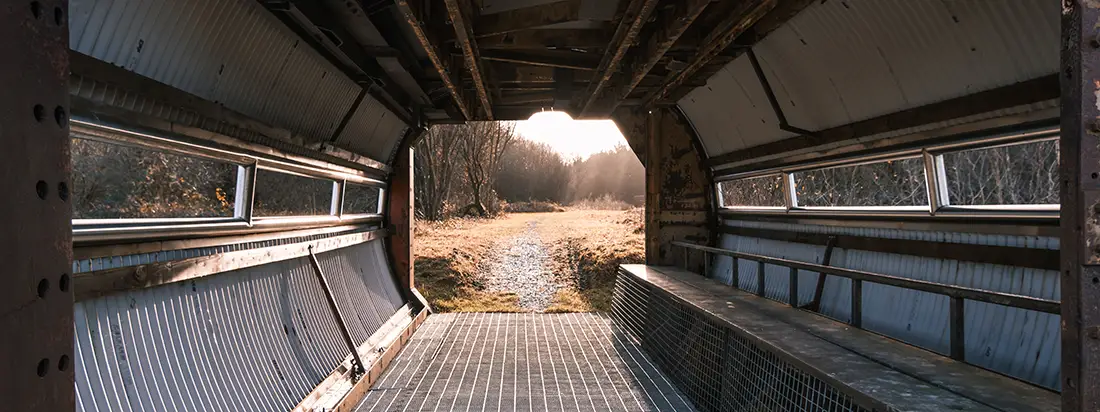
By Kevin O’Dwyer
A tunnel bridge of steel allowing you to journey through the parklands.
Concept Description
The sculpture was influenced by the Nissen huts used in the 1940’s and 50’s to house BnM workers during the peat harvest at Boora. The stainless steel slots create a visual cut in the landscape when viewing from inside. The big sky in the Boora landscape can be overwhelming and this cut helps the visitor focus on the landscape around the canal. This piece combines the functional i.e. bridge, shelter and bird hide with sculptural industrial aesthetic.
Materials Description
The sculpture uses a recycled Tippler that was used at the Ferbane power plant to unload peat from the incoming carriages. The tippler is wrapped in galvanised steel and incorporates stainless steel slots.
Raised Line
Raised Line
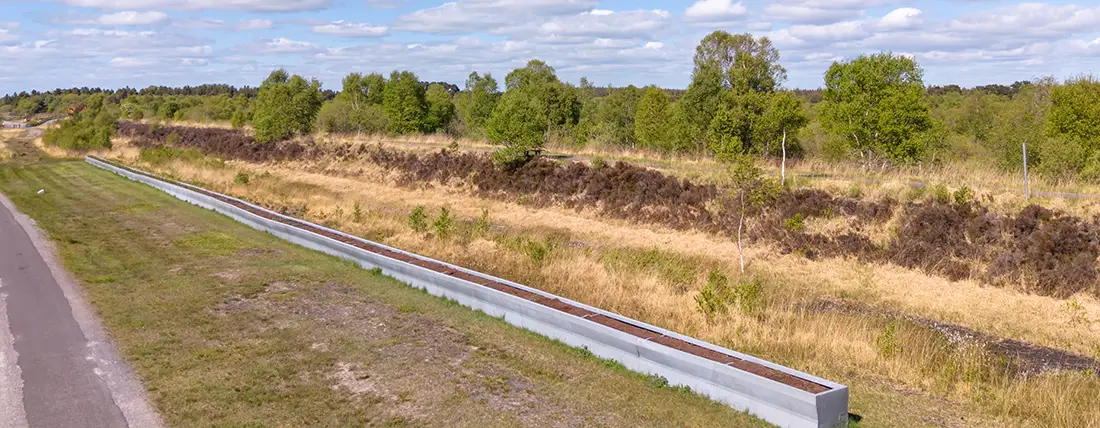
By Maurice MacDonagh
At just over a metre high, Raised Line stands as a line in the landscape, in the same way that old peat beds have left lines over the years.
Concept Description
Harvested peat has inherent limitations as a material for Land Art. It is vulnerable to erosion as to be unstable, yet it is the core substance of Lough Boora. This thought led Maurice to the idea of containment – to create a container for the harvested peat within a form that derives from, and is relevant to, the landscape of Lough Boora Discovery Park.
Everything about Boora is essentially horizontal in form: the peat works, machine paths, rails, roads, even the waterways are linear. The artist used this idea to form the piece – a 100m long galvanised steel container to be filled with harvested peat. At just over a metre high it will stand as a line in the landscape, in the same way that old peat beds have left lines over the years.
Boora Stacks
Boora Stacks
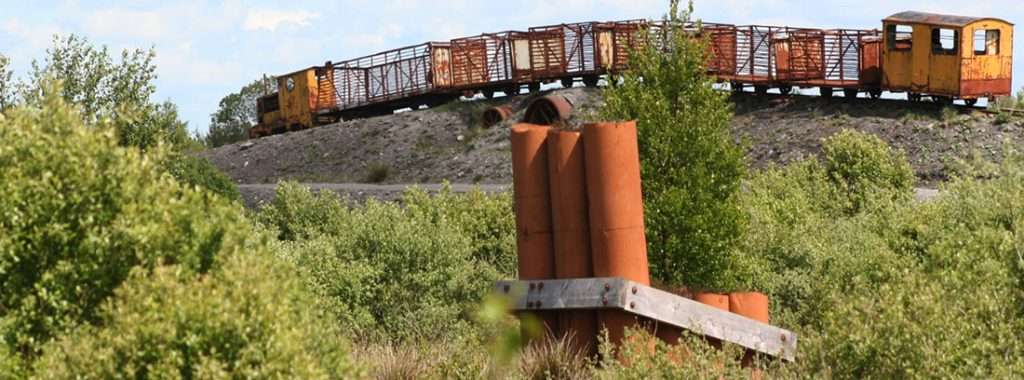
By Naomi Seki
Eleven former chimney stacks framed by Douglas fir enriched by heather and birch.
Concept Description
The chimneys were filled with peat and set into a specially constructed wooden frame made of Douglas fir. The stacks were planted with heather and birch, both native to Lough Boora Parklands. The artists’ intention was to give life back to the chimney stacks within the landscape.
Materials Description
While working in the fabrication workshops of Boora Works Naomi found some disused chimneystacks. She was attracted to their colour and texture and decided to make a sculpture, which incorporated eleven of the former chimneystacks.
The Celtic Knot
The Celtic Knot
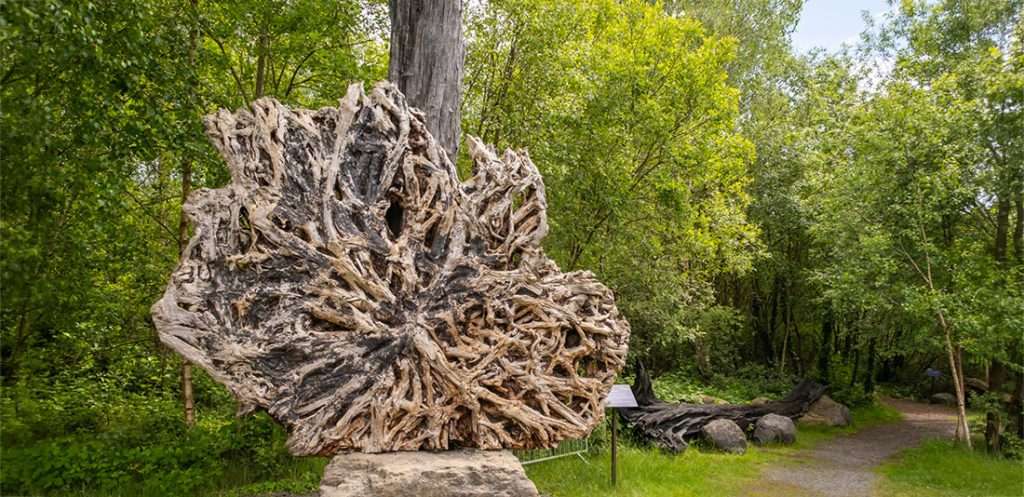
By Padraig Larkin
A knot symbolises the Celts’ belief in the continuity of life into eternity its loops have no beginning or end.
Concept Description
The gnarled root of a pine tree, 5,000 years in the earth, is pinned by a single bolt to a trunk of bog oak, eight of its twenty feet anchored underground. The installation sits on a glacial rock and is surrounded by a circle of smaller stones.
All of the materials, which are local and of the landscape, link past to present and are woven together to illustrate the cyclical motion of life.
Miniature birch and pine trees have started to sprout from random seeds in this ancient root, a sign of nature reclaiming its children; that in endings there are beginnings.
Raised Circle
Raised Circle
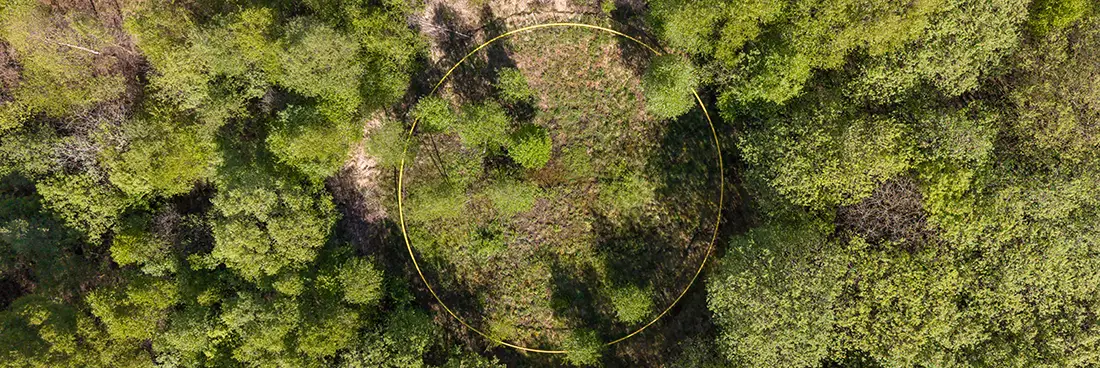
By Maurice MacDonagh
A yellow steel rail track floating above the landscape appearing with the seasons.
Concept Description
Hundreds of miles of rails traverse Ireland’s bogs as narrow-gauge locomotives go to and fro, pulling long trains of turf wagons to power stations. Maurice MacDonagh’s Raised Circle, fabricated from this narrow-gauge rail, floats one metre above the landscape.
The rail is painted “BnM yellow”, which is found on everything from locomotives to turf harvesting machinery. This yellow circle floats above the ever-changing plant-life of the cut away bog, often disappearing during the summer season and re-appearing during autumn.
A-Maze-In Willow World
A-Maze-In Willow World
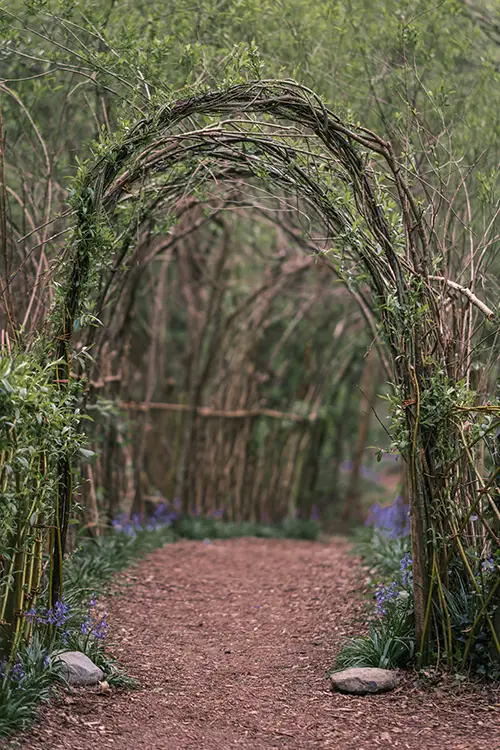 By Padraig Larkin
An oasis in the bog where everything else is destined to decay, Willow World was constructed with live willow rods and like the childish imagination, will last forever.
Concept Description
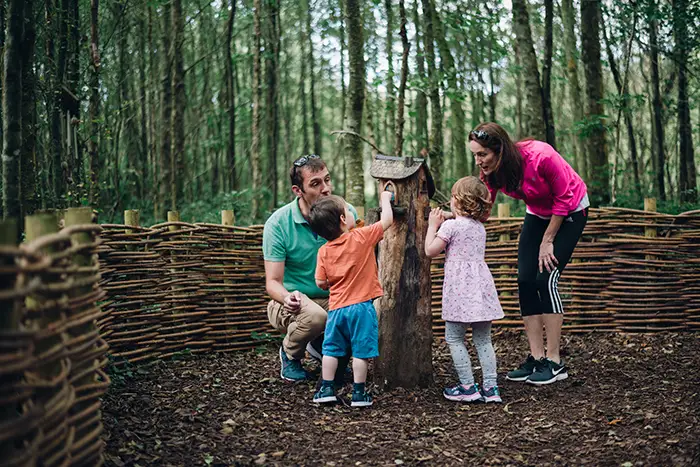
From the moment children step into Willow World, they are invited to embark on a wondrous playground adventure. At every twist and turn, they catch a glimpse of a tunnel, a tepee, a beehive or an igloo.
In between are picnic areas, a loveseat, a bower; places to rest and observe the beautiful bog oak structures. They can imagine a whale with a dorsal fin, a bear eating a fish, is that an old hag lurking in the trees? What about a spinning ball, a heart, even a secret passageway through the woods?
A-maze-in Willow World presents a puzzle. Complex paths are flanked by eight foot high willow osiers, forming a labyrinth of routes that guide the solver to the centre, the core, the inner child in all of us.
Regeneration
Regeneration
By Kevin O’Dwyer
This sculpture represents the seed falling and the growth of new beginnings.
Rising 6 metres (20 feet) into the open Offaly sky, Regeneration has taken its place among the park’s renowned site-specific works from national and international artists. Fabricated from steel, the sculpture’s surface will weather naturally over time, developing a warm, organic patina that reflects the parklands’ own transformation from a post-industrial bog to a thriving biodiverse sanctuary.
The form of Regeneration draws inspiration from the seed—an elemental, universal emblem of growth and new beginnings. Through a repeated, abstracted seed motif, the sculpture references cycles of renewal found in ecosystems across the world, from wetlands and forests to coastlines and human communities.
The work reflects the park’s ethos of balance between human legacy and natural process, bridging industrial material with organic form. Its careful siting within the sculpture park will ensure harmony with both the surrounding artworks and the expansive midlands landscape.
Light as a Feather
Light as a Feather
By Kevin O’Dwyer
Light as a Feather is a striking minimalist sculpture suspended with quiet elegance above the canal in Lough Boora Discovery Park. Designed to hover visually over the water’s surface, the elongated feather form casts shifting reflections that change with light and movement, creating a lyrical dialogue between metal, landscape, and sky. Evoking lightness, freedom, and transformation, the piece takes its inspiration from the delicate, transient motion of feathers carried by air and water. As part of O’Dwyer’s site-responsive practice, Light as a Feather invites viewers to reflect on the canal’s flow and the balance between the physical and the ethereal. Seamlessly bridging contemporary sculpture and natural environment, the work embodies O’Dwyer’s signature fusion of minimalism, craftsmanship, and environmental awareness.
Artist Statement – Light as a Feather
Light as a Feather continues my exploration of how sculpture can create dialogue between form, place, and the natural environment. Suspended above the canal in Lough Boora Discovery Park, the work draws its inspiration from the delicate, fleeting motion of feathers carried by air and water. The feather form, elongated and pared back to its essence, was conceived to hover visually above the water’s surface, casting shifting reflections that merge metal, light, and landscape into a single, changing composition.
In this work, I wanted to evoke themes of lightness, freedom, and transformation—qualities that speak to both the natural world and the human imagination. By responding directly to the canal’s flow and the surrounding landscape, Light as a Feather seeks to offer viewers a moment of contemplation, a pause in which the boundary between the physical and the ethereal feels porous. As with much of my practice, the piece reflects my ongoing interest in minimal form, crafted detail, and the ways in which sculpture can inhabit and be transformed by its environment.
Black Forest
Black Forest
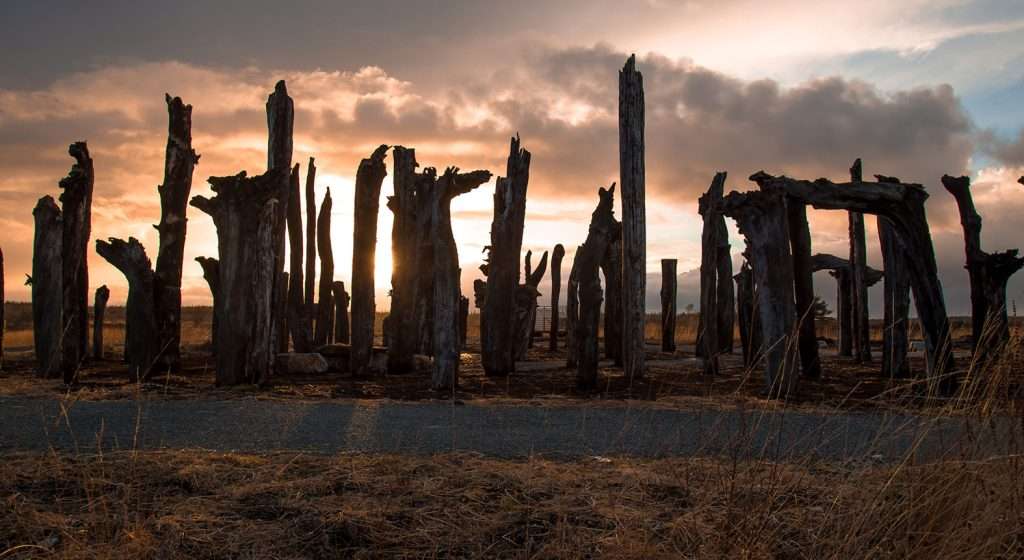
This piece was put together by BnM works staff and is made up of oak trees that were preserved by the bog. These trees fell over due to the wet and marshy conditions and lay in the bottom of the bogs for 5,000-6,000 years. They were dug up in this condition by BnM while those bogs were being harvested for peat production. This piece is a testament to those trees that grew here so long ago.